The defense’s effort to challenge a financial analysis in Vice President Sara Duterte’s impeachment trial ran into a basic problem: its witness hadn’t read the report or examined the records behind it. Senator-judges questioned how he could assess the findings without that material, while prosecutors challenged the scope of his financial-investigation experience. The dispute turned on a practical question: what can an expert meaningfully say about a specific analysis when he hasn’t examined the evidence it rests on?
Lawyer Rainer Dela Fuente, a former Anti-Money Laundering Council (AMLC) investigator, appeared as a defense expert on Day 44 of the trial on Thursday, November 19. He was listed to discuss legal concepts under the Anti-Money Laundering Act (AMLA). Defense lawyer Mark Vinluan asked him to address the methodology and conclusions in a financial forensic report prepared by prosecution witness Alex Cabrera, putting the report’s reliability at the center of his testimony.
Dela Fuente said he hadn’t received the report or its supporting records before testifying. Asked whether he’d reviewed AMLC records, bank statements, insurance placements and company general information sheets linked to Duterte, he answered, “No, Your Honor.” Vinluan said the defense planned to focus on selected passages in the 50-page report. That approach left the senator-judges with an immediate question: whether those excerpts could be assessed without the surrounding analysis and source documents.
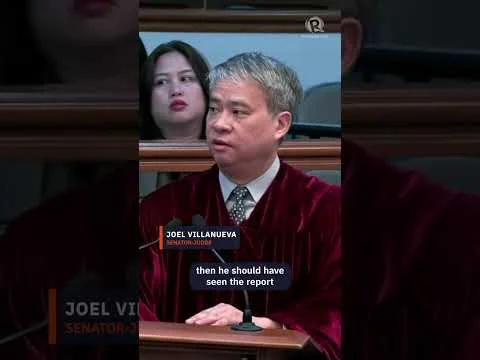
Senator-judges question the basis for his testimony
Senator-judge Joel Villanueva pressed the defense on how Dela Fuente could refute a report he hadn’t read. If the witness couldn’t answer questions about it, Villanueva said, his testimony would be “useless.” Senator Erwin Tulfo also questioned the value of opinions formed without reviewing Suspicious Transaction Reports and Covered Transaction Reports, saying the testimony risked amounting to theory and personal belief.
Tulfo criticized the defense’s recent witnesses and urged it to present someone able to withstand questions from the senator-judges. His challenge went beyond courtroom performance: a witness asked to assess a financial report needs a basis for addressing its methods and evidence. Dela Fuente, for his part, said he was responding to hypothetical questions based on his understanding of the law, not rejecting Cabrera’s findings.
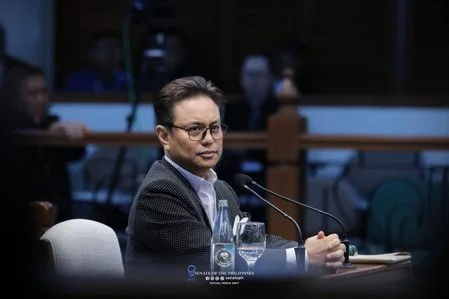
He cited confidentiality concerns and said he hadn’t had access to the report. He also explained that he chose not to read it because he feared doing so would bias his testimony. “My only basis is our AMLA, and our laws, so I can answer based on the law,” he said.
That reasoning drew a line between explaining legal standards and evaluating whether Cabrera applied them properly. General knowledge of the law can frame questions about a financial investigation, but it can’t establish whether a particular conclusion follows from particular records. The distinction matters in a hearing where the witness was asked to address both methodology and findings.
Prosecution challenges his experience
Prosecutor Diokno focused on Dela Fuente’s qualifications, asking whether his claimed expertise in financial investigation came from 25 months as an entry-level AMLC investigator. Dela Fuente agreed. He also said he wasn’t contesting the accuracy or truthfulness of AMLC reports, Securities and Exchange Commission records or bank records involving Duterte.
Diokno argued that reviewing only selected passages could leave out context needed to judge a financial report’s reliability. He asked whether Dela Fuente would consider it fair if someone evaluating his own investigation report skipped much of it. The analogy pointed to a familiar problem in document review: an excerpt may be accurate on its own while still omitting information that changes how a conclusion should be understood.
The exchange didn’t establish that Cabrera’s analysis was correct or incorrect. It exposed a limit on what Dela Fuente could address: he hadn’t reviewed the evidence, and he wasn’t disputing the underlying records. The defense’s case for scrutiny therefore had to rest on general legal principles and questions about the report’s presentation, rather than a competing examination of its contents.
The exchange centered on Cabrera’s earlier testimony that his analysis of financial and bank records found that Duterte and her husband, Mans Carpio, had accumulated P817 million in unexplained wealth from 2022 to 2025. Duterte is facing allegations of unexplained wealth under Article II of the Articles of Impeachment. The figure is an allegation presented through the prosecution’s witness; the hearing described here concerns how the defense sought to test the analysis behind it.
What the testimony leaves unresolved
The hearing exposed a gap between the defense witness’s stated role and the material available to support his answers. Without reviewing the analysis or its underlying records, Dela Fuente’s testimony was confined to general legal principles, leaving the report’s specific findings largely unaddressed. This is more significant than it looks: in a financial case, the method and the documents are closely tied, and criticism of one is harder to make persuasive without engaging the other.
For the senator-judges, the episode raised a question about the practical value of expert testimony that stays at the level of hypotheticals. If you’re following the trial, the key distinction is whether a witness can explain the law in general or test how an analyst applied it to specific records. Here, the defense witness described the first task; the questions in court focused on why he couldn’t perform the second.
And yet, the exchange doesn’t settle the merits of Cabrera’s report. It shows that this particular challenge, as presented, left the senator-judges without a direct review of the underlying material from Dela Fuente. The evidentiary dispute remains. That’s the part most people overlook.
For future questioning in the trial, the same tension is likely to matter whenever a witness is asked to assess financial conclusions: expertise has to connect to the evidence under discussion. A legal framework can help identify what to examine, but applying it to a report requires access to the report and a clear account of its records. In this hearing, that connection was missing. A narrow basis for challenge.

