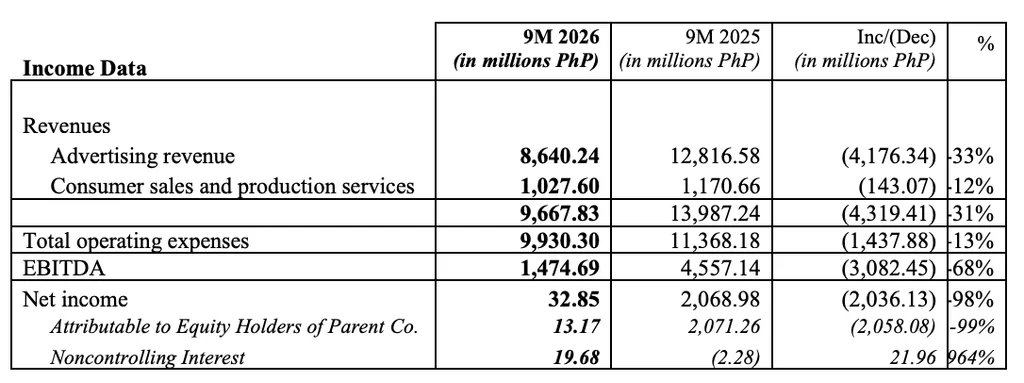
GMA Network's third-quarter net income fell from P2 billion a year earlier to P32.85 million, a 98% drop. The steep decline shows how much of last year's cushion came from political advertising tied to the 2025 midterms. Revenue fell 31%, or P4.3 billion, and EBITDA dropped 68%, from P4.5 billion to P1.4 billion.
Here's the thing: a 98% drop makes a strong headline, but the percentage hides how small the remaining profit is in absolute terms. The more useful read is the revenue and EBITDA lines underneath it. When a broadcaster loses nearly a third of its top line in one quarter, the cause is rarely a single bad show or one lost client. This pattern usually points to a shift in the business model, or to a year that flattered the numbers and a year that didn't.
If you're tracking Philippine media companies, the comparison base matters more than usual this time. Last year's third quarter was inflated by spending that doesn't recur on a normal schedule. That makes the year-over-year decline look worse than the underlying business may be. And yet the company's own disclosures suggest the drop reflects more than timing.
The midterm hangover hit ad sales hardest
Advertising did most of the damage. Ad revenue dropped 33%, from P12.8 billion in Q3 2025 to P8.6 billion this year. GMA blamed the absence of political advocacies and ads tied to the 2025 midterms, along with a "softening of recurring revenues year-on-year." It also pointed to the "continued shift of audiences and advertising budgets from traditional media to digital platforms."
The arithmetic is blunt. Ad revenue fell by roughly P4.2 billion, and total revenue fell by P4.3 billion. That means almost the entire decline sits in advertising, and the other revenue lines barely moved on a net basis. For a network that depends on advertisers, that's a concentrated kind of exposure.
Political advertising is lumpy by nature. It tends to spike in the months around an election and then drop off sharply, which makes the quarter after a midterm a bad comparison point. I'd argue GMA's "softening of recurring revenues" line deserves more attention than the political explanation. Recurring revenue is supposed to be the dependable part of the business, so any softness there is harder to write off as a one-time effect.
Costs made things worse. GMA cited elevated fuel prices, persistent inflation, supply chain disruptions, rising labor and utility costs, and geopolitical uncertainty tied to the Middle East conflict. The network said these pressures "squeezed profit margins" and made advertisers more cautious about spending. That's a tough combination: fewer ad dollars and higher costs to produce and distribute content.
That said, cost pressure works differently from ad softness. Advertisers can pull budgets within a single quarter, but a broadcaster's bills for power, fuel, staff, and production keep arriving on schedule. Companies in this position usually have limited room to cut without hurting the programming that draws the audience in the first place. So the squeeze compounds: the revenue side shrinks while the cost side resists.
Ratings leadership isn't paying the bills yet
Here's the thing: GMA still leads on the screen. Nielsen TV Audience Measurement data ranked it the top television station nationwide for the first three quarters. Its top programs include Kapuso Mo, Jessica Soho and the flagship nightly newscast 24 Oras. Its radio stations, Super Radyo DZBB and Barangay LS 97.1, also lead in ratings.
Audience share alone doesn't close the gap, though. Ratings tell advertisers who's watching, but what a network earns depends on who's buying, how much they'll pay, and whether they're willing to commit money during a weak period. A leader with a shrinking ad base can still see its revenue fall. That's the uncomfortable position GMA finds itself in right now.
GMA's digital advertising is now its "second largest revenue contributor," which confirms that online platforms are becoming a core revenue line rather than a side project. (And this is the part most people overlook: the digital business is growing into a position where it has to offset declines in traditional advertising, not just add to them.) If you're watching how legacy broadcasters adapt, that's the test to watch. Digital is no longer optional, but the company hasn't yet said how large that line needs to be to replace what's leaving.
ABS-CBN's loss widened as content sales carried the load
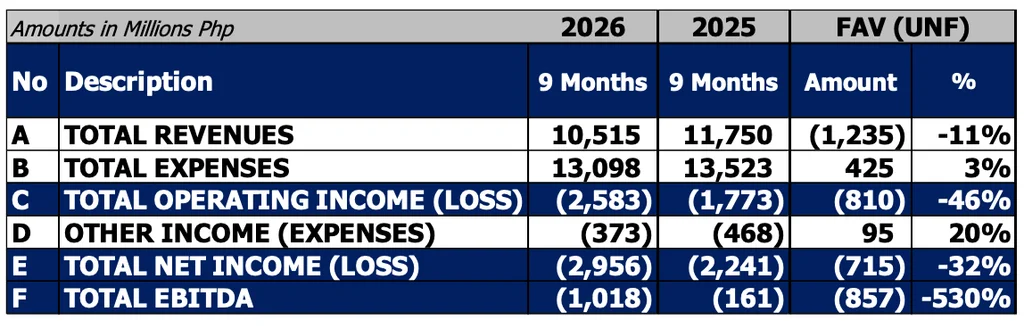
ABS-CBN Corporation reported a consolidated net loss of P2.95 billion in Q3 2026, up from P2.24 billion a year earlier. Total revenue fell 11%, from P11.75 billion in an election year to P10.5 billion. The company blamed "global economic and geopolitical developments," slow domestic growth, and weak consumer and business sentiment that "weighed on advertising and subscription demand in both segments."
The loss is the more worrying number of the two. GMA's profit fell to almost nothing, but ABS-CBN's loss grew by roughly P710 million while its revenue also shrank. Both companies are facing the same macro pressures, yet ABS-CBN is absorbing them from a weaker starting position. Its losses are not a new problem, which is part of why the widening stands out.
Licensing and international syndication, plus co-production revenue, cushioned the fall. ABS-CBN said that growth "offset the decrease in advertising and other consumer revenue streams." Live events and film helped too. Star Cinema released Tayo Sa Wakas in May, and BINI's world tour began in June, following the group's April appearance at Coachella. ABS-CBN Global staged 27 events across international markets, including two sold-out ASAP XP Australia shows in July. The DonBelle love team of Donnie Pangilinan and Belle Mariano also drove strong interest during the period.
Live events are a useful reminder of how different this kind of revenue is from advertising. Ticket sales and sponsorships come in bursts tied to specific dates, and they don't depend on whether a brand's marketing team feels confident that quarter. That makes them attractive for diversifying, but harder to forecast. A tour that sells out in one market doesn't guarantee the next one will.
ABS-CBN has been pivoting to digital since losing its broadcast franchise in 2020. It now sells content to former rivals GMA and TV5 and partners with them on productions. Fresh capital from new investors is helping the company absorb the disruption, though the loss figures show how deep that hole still runs. The content-licensing strategy is an odd kind of competition, where the company profits from supplying the networks that once competed with it for the same audience.
What this means for the rest of the year
The real question for both networks is whether digital and content sales can replace shrinking ad revenue fast enough to matter. Neither company has shown that yet. Each has found a partial answer, and each is still paying for the gap in the meantime.
GMA's ratings and digital momentum give it a stronger hand on paper. Its problem is that the audience advantage hasn't translated into ad dollars, and the digital line is still described as a contributor rather than a replacement. ABS-CBN has shown it can monetize its library and talent abroad, which is a real strength. But licensing and live events are lumpy, and they don't fully offset a broad drop in consumer and business spending.
If you're working in this space, the next quarter's advertising numbers will tell you more than any single earnings headline. Watch whether the ad decline holds once the election-year comparison goes away. If it does, the cost pressures and weak sentiment become the real story, and the strategies these companies are betting on will face their hardest test. If it doesn't, the question becomes whether digital can grow fast enough to fill a hole that's no longer seasonal.

