The 2032 target faces a long road
The Philippines’ 2032 target for its first nuclear power is running ahead of the institutions and negotiations needed to build a plant. William Magwood, director-general of the OECD Nuclear Energy Agency, says a reactor is unlikely to be operating within six years; reaching a project decision in that period may be more realistic. That distinction matters: choosing a project would mark progress, but it wouldn’t mean construction is ready to begin, much less that electricity is close to reaching the grid.
“There’s a lot of discussions that have to be had between governments, between the utility and vendors. These take years to go through,” Magwood told reporters on Wednesday, November 4. He said the Philippine regulator is still at an early stage, adding that a reactor could arrive “within the foreseeable future if things stay on track.” His remarks describe a process in which negotiations, regulatory preparation and technical planning have to advance together. A political target can set direction, but it can’t compress all of those tasks into a single deadline.
His assessment follows President Ferdinand Marcos Jr.’s confirmation less than a month earlier that the government could meet its target of adding 1,200 megawatts (MW) of nuclear capacity by 2032. Energy Secretary Sharon Garin has since indicated that the schedule is under reconsideration. The gap between those statements leaves a basic question: does the target refer to capacity actually operating by 2032, or to a major decision that would put a future plant on a credible path?
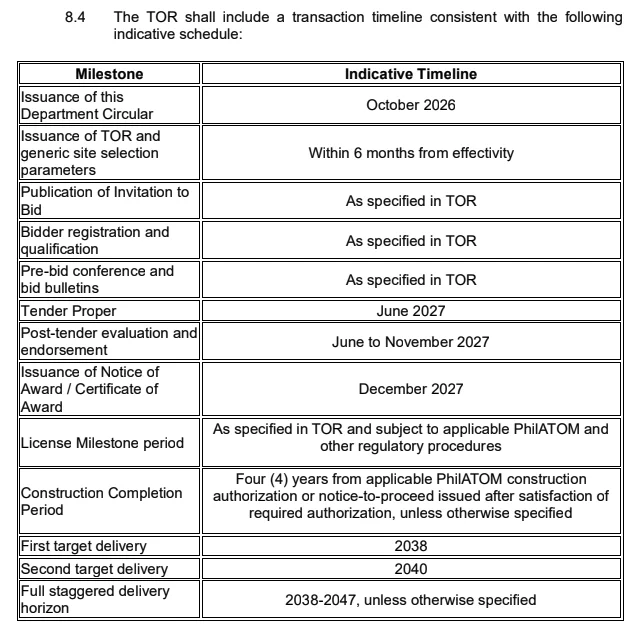
The Department of Energy’s draft nuclear capacity tender points to a slower start: its first planned electricity deliveries are set for 2038. That date covers projects pursued through the proposed tender, so projects arranged through other channels could follow a different schedule. DOE Director IV Patrick Aquino said the department would stick to the draft plan for now, while remaining hopeful about progress. The numbers here are underwhelming for anyone reading 2032 as a date for nuclear electricity, but a tender timeline is still a planning document rather than proof of when a plant will be completed.
Building the institutions and workforce
Project timelines depend on more than choosing a technology or site. The Philippine Atomic Energy Regulatory Authority, or PhilATOM, is still waiting for its leadership to be appointed, and its implementing rules remain unfinished. Those are foundational pieces: a regulator needs authority, procedures and qualified staff to assess a project and oversee the work. The DOE has been convening forums and engaging nuclear experts, suppliers and developers as it works to build the program, but discussions alone don’t establish those capabilities.
Aquino said the department is also investing in workforce development and technical cooperation with countries that operate nuclear plants. Magwood warned that finding qualified specialists is difficult even in OECD member countries. A regulator needs expertise across engineering, science, geology and other fields, and developing that bench takes time. Hiring people with relevant experience can help, but the institution also needs the systems and continuity to apply that expertise through a project’s many stages.
If you’re working in this space, the staffing question is easy to underestimate. Nuclear programs need people who can assess technical proposals, scrutinize safety cases and maintain oversight over the life of a facility. And this is the part most people overlook: workforce development has to keep pace with the project, not simply precede it. A schedule that depends on expertise the country is still building carries uncertainty at each step.
The Philippines has potential nuclear sites under assessment in Bataan, Palawan, Masbate, Pangasinan and Camarines Norte. The DOE has reported 60% to 90% support in communities being considered, depending on location, and is preparing another nationwide survey. Those figures suggest support is substantial in some places, but they also leave room for meaningful local differences. National averages can’t answer the questions residents near a proposed site may have about safety, emergency planning or what happens to waste.
Support and waste plans remain central
National backing has risen in DOE surveys from 79% in 2019 to 82% in 2024, but public acceptance isn’t uniform. Magwood said some parts of the country show strong support while others are less receptive, a variation he described as typical. For communities near a proposed plant, concerns include safety and the long-term handling of radioactive waste. Public support, then, is not a single hurdle that can be cleared once; it depends in part on how clearly authorities address local concerns.
Spent fuel can be kept for decades in specialized storage containers before eventual disposal in geological repositories, Magwood said. But technical options haven’t removed the emotional weight of the issue for host communities. The Philippines has yet to decide how it would handle final disposal, making its eventual cost difficult to estimate. That uncertainty affects more than accounting: a credible project plan needs to explain how waste will be managed over time, even when the final destination hasn’t been chosen.
What the timeline will depend on
The near-term test is whether the country can establish a capable regulator, train specialists and settle its approach to waste while project discussions advance. Those steps will shape whether the 2038 tender schedule holds—and whether nuclear power can move from a capacity target to a buildable plan. That’s a long list of prerequisites for a program still at an early stage. The work ahead.
For now, the public timeline contains two different signals: a 2032 government target and a draft tender that points to first electricity deliveries in 2038. The distinction between a decision, a plant under construction and an operating reactor should stay clear in the debate. If institutions and negotiations take years, as Magwood says, then the pace of preparation will matter more than repeating the earlier target. A project decision could be a meaningful milestone, but it wouldn’t settle the questions of regulation, workforce, local consent or waste.
What this means for you is that the headline date offers only a partial picture. The more revealing measures will be whether PhilATOM gains leadership and rules, whether the DOE’s planning develops into a defined procurement process, and whether communities receive answers to the concerns raised by a plant. The 2032 goal may keep attention on the issue; the institutions and decisions built around it will determine whether it can be delivered.