Rising household costs are colliding with weak economic ratings for Donald Trump as the US heads toward midterm elections. A Reuters/Ipsos poll puts his overall approval at 32%, while Democrats lead Republicans on the generic congressional ballot. The figures suggest economic frustration is reaching beyond the usual partisan divide.
Thirty-five Senate seats are up for election, and Democrats need to gain at least four to increase their numbers in the chamber. Polling shows Democrats ahead in many battleground states, while voter discontent has put some traditionally Republican seats in play.
The pressure is visible in prices for fuel, energy and food. The data also show a sharp decline in confidence in Trump’s economic performance, including among Republicans. Here’s the thing: the election stakes are national, but much of the discontent starts with costs people encounter every day.
Inflation remains above its early 2025 level
The 12-month increase in the Consumer Price Index was 3% in January 2025, then fell to 2.4% in March 2025. By May 2026 it had climbed to 4.2%; in September, it stood at 3.7%.
That annual measure compares the cost of a basket of everyday goods and services with the same month a year earlier. Its rise points to renewed strain on household purchasing power after inflation had eased earlier in Trump’s second administration.
The article links the increase to the war with Iran and disruption to supply chains following the closure of the Strait of Hormuz. The scale of the energy shock is clear in fuel prices, though food costs have also risen for a mix of reasons.
Fuel costs put the squeeze on drivers
Gas prices surged after the war began and Iran blocked the Strait of Hormuz. The 12-month increase for gas reached 40.5% in May 2026, after two months of war. It eased into the mid-twenties over the summer, then rose to 34.2% in September.
National averages put a monthly figure on the change. Drivers using unleaded gasoline were paying an average of $66.86 more per month than in October 2025. For diesel drivers, the increase was $139.32. AAA data show prices were $1.23 higher per gallon for gas and $2.83 higher for diesel than a year earlier.
Energy costs, including electricity and home heating products, rose 23.5% over 12 months at their May peak. By September, the increase was 20.4%. Before the conflict, about one-fifth of global daily oil and liquefied natural gas supply passed through the strait. Trump has tried to pressure Tehran through military action and negotiations, but those efforts have not ended the blockade.
Food costs keep climbing
Food prices were already rising in the final months of the Biden administration in late 2024, and continued upward during Trump’s first year back in office. The annual increase for all food was 2.5% when he took office. It reached 3.2% in August 2025, then hit that same rate again in April 2026.
The pressures behind grocery prices include tight labor markets, climate disruption and trade policy, including Trump’s tariffs. Restaurant meals have also become more expensive: the 12-month increase for food away from home rose from 3.4% in January 2025 to 4.1% in December, before easing to 3.5%.
Economic approval is a weak point
Trump’s overall approval has struggled since he returned to office in January 2025. In a Reuters/Ipsos poll conducted the week before the article’s publication, registered voters favored Democrats on the generic congressional ballot by 47% to 36%. Among likely voters, the margin was 53% to 44%.
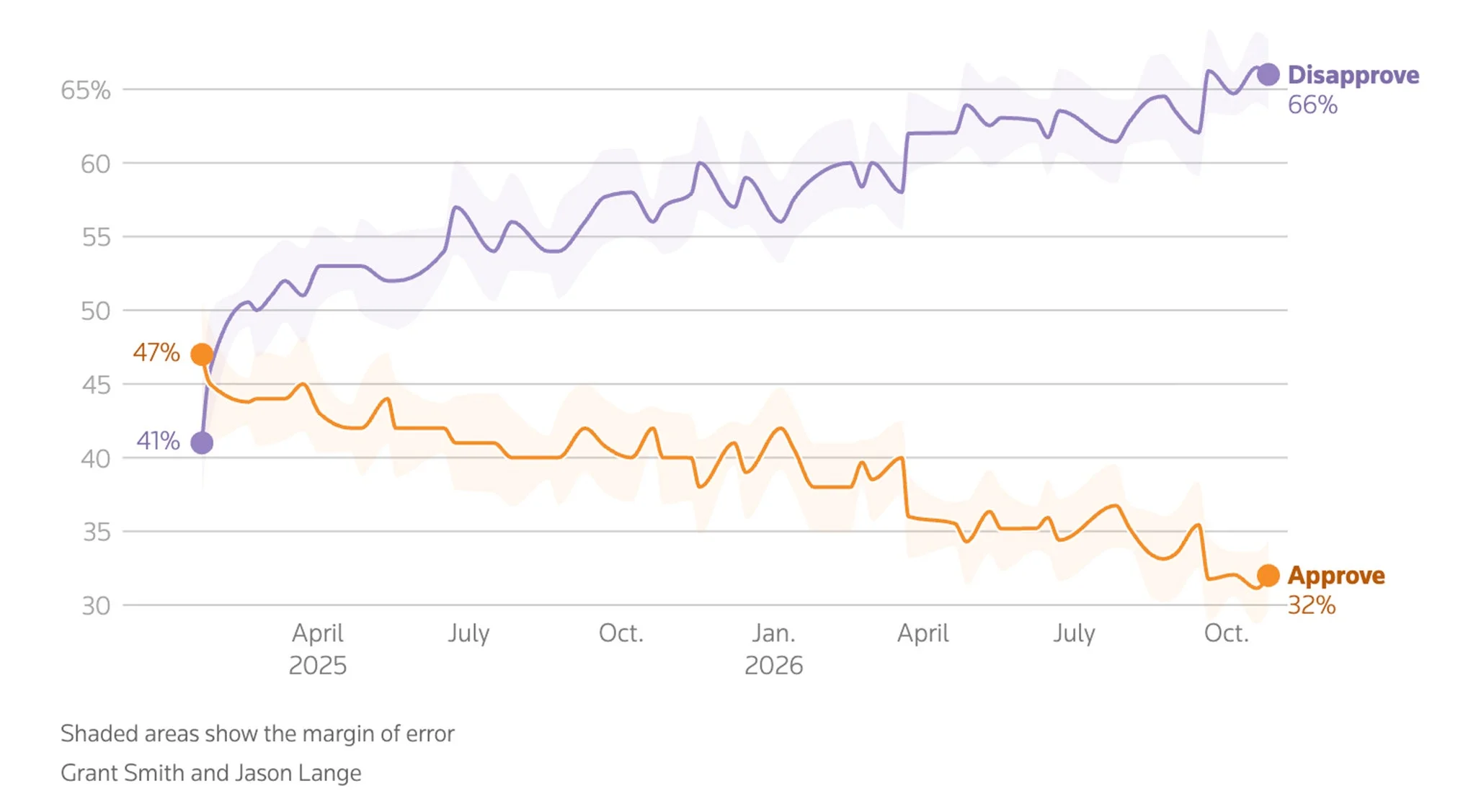
His rating on the economy has fallen to 21%, a new low for his second administration, according to the Pew Research Center. Only 36% of Republicans say the economy is in good shape, down from 41% in July.
Views of his economic policies are more negative still: 65% of Americans say those policies have made conditions worse, while 19% say they have made things better. Expectations for the year ahead are subdued, too. Just 26% expect the economy to improve; 34% expect it to stay about the same, and 39% think it will worsen.
That combination of high costs and dim expectations gives Republicans a clear vulnerability as voters weigh in on control of Congress. Whether the polling translates into Senate seats will depend on individual races, but the economic figures show why the party faces an uphill campaign.

