When an ad implies a medicine
The Advertising Standards Authority’s latest rulings put the focus on what an ad suggests, not just the words it uses. Four campaigns for weight-loss tablets were banned after the watchdog concluded they promoted prescription-only medicines to the public. The decisions turn on the full impression a campaign creates: images, slogans, surrounding claims and the route a viewer is sent to can all shape what a product appears to be.
That approach matters in advertising for treatments that are becoming more familiar to consumers. A campaign can avoid naming a medicine and still point clearly enough towards a category of prescription product. The ASA’s position is that advertisers can’t assess each phrase in isolation when the message emerges from the ad as a whole.
Voy’s campaign and the role of context
Two of the ads were for Voy’s “The weight is over” campaign. One, displayed on a bus in July, showed a hand holding a white tablet beneath the line “The weight is over… Voy”. Another, shown on video-on-demand services in August, paired a pill with the phrases “Oral weight support” and “It’s kind of a small deal”. The wording was suggestive rather than explicit, but the pill image and references to oral weight support gave viewers a concrete reason to connect the campaign with a weight-loss medicine.
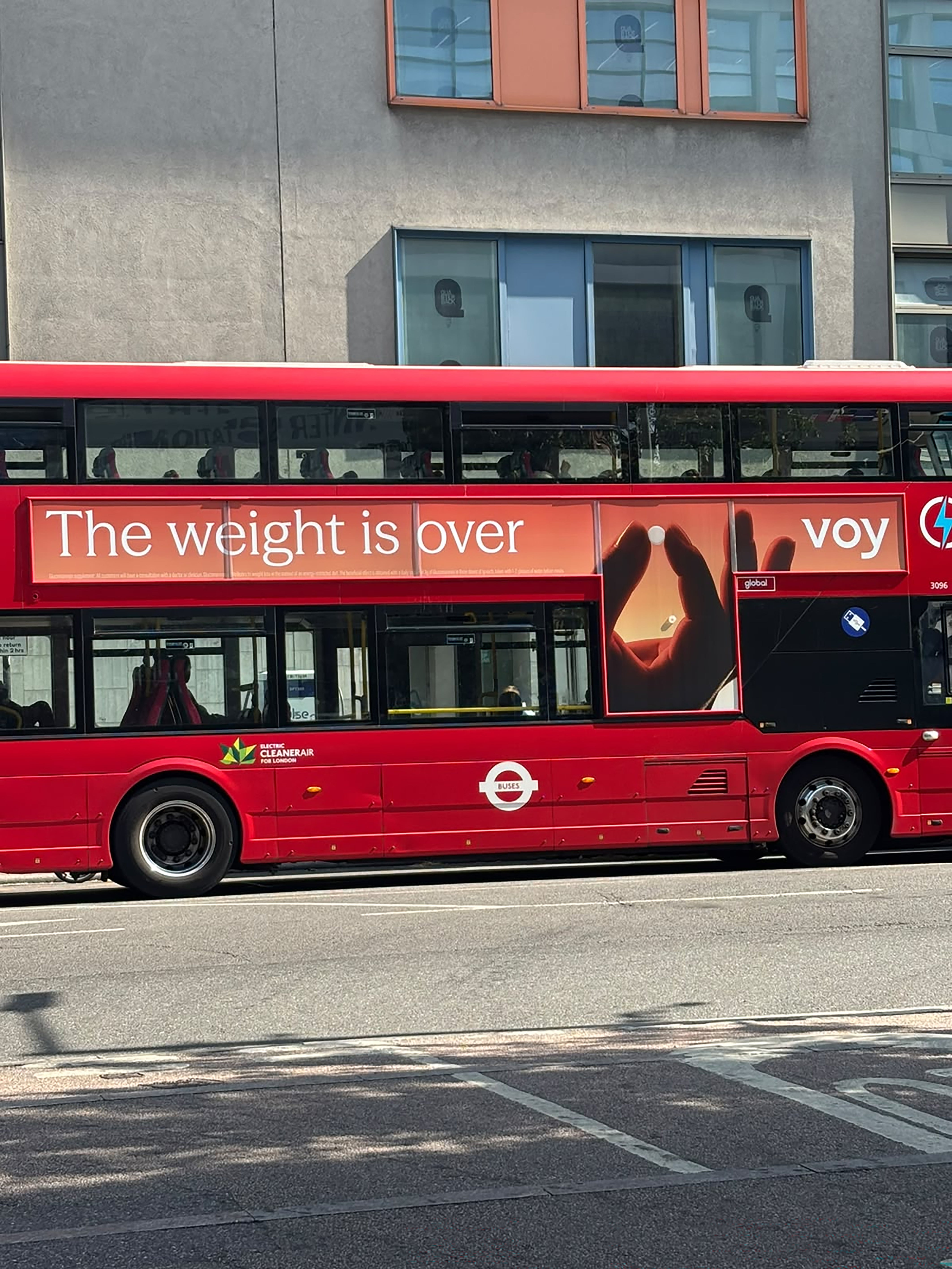
The ASA said both ads were likely to be understood as promoting the newly available oral Wegovy tablets, rather than a food supplement. The first GLP-1 tablet for weight loss was licensed as a prescription-only medicine in June. Medicines available only on prescription can’t be advertised to the public.
Voy’s small-print references to glucomannan didn’t alter the overall impression, the ASA said. That judgment reflects a familiar problem in advertising: a qualification can be technically present yet do little to change what a viewer takes away from a prominent headline or image. The video ad also directed viewers to a website featuring prescription-only weight-loss medicines, reinforcing that reading. Here's the thing: where an ad sends people can help explain what the ad itself is selling.

Similar findings across other campaigns
The other two rulings concerned Juniper and MedExpress. A YouTube ad for Juniper declared, “The weight loss pill is here”. MedExpress used Instagram to promote “New weight loss tablets” and “No needles”, then invited users to “Join the waitlist”. Neither company needed to name a specific medicine for the ASA to find that the ads implied one was being promoted.
The distinction is significant for campaign design. “No needles” frames the product in relation to injectable treatments, while “the pill is here” presents a tablet as an available answer to weight loss. A waitlist invitation can add to that impression by suggesting that a particular product is forthcoming. This is more significant than it looks: the regulator’s concern isn’t limited to a medicine’s brand name or formal product description.
The decisions follow earlier bans involving Simple Online Pharmacy and Pharmacy Online. Those firms had advertised oral GLP-1 treatments on social media and their websites, inviting people to join waiting lists, register interest and pre-order. The rulings marked the first bans over ads promoting unlicensed and prescription-only oral weight-loss products to the public. Taken together, the cases show the ASA applying the same basic question to different formats: what would an ordinary viewer understand the campaign to be promoting?

What the watchdogs say
Catherine Drewett, the ASA’s investigations manager, said advertisers must account for the full impression their campaigns create. “A medicine doesn’t need to be named for an ad to be understood as promoting a prescription-only medicine,” she said, adding that small-print references to a non-medicinal product may not change that impression. The ASA is using AI monitoring to keep the sector under review, Drewett said. That signals an effort to watch advertising across a busy category, though the rulings themselves show that human interpretation of the finished ad remains central.
Julian Beach, executive director of operations at the Medicines and Healthcare products Regulatory Agency, welcomed the rulings and said the MHRA works with the ASA on inappropriate medicine advertising. “Prescription medicines are not consumer goods,” he said, describing the restrictions as safeguards intended to support treatment decisions between patients and healthcare professionals. The point is that promotion can shape expectations before a patient has discussed whether a treatment is appropriate with a clinician.
Voy’s chief medical officer, Dr Earim Chaudry, said the company believed its campaigns had been developed in line with UK advertising standards. Voy withdrew the advert while the investigation was under way and, Chaudry said, won’t run it again. He added that the company cooperated with the ASA and acted on its feedback. The company’s account and the regulator’s ruling sit side by side: advertisers may consider a campaign compliant, but the ASA judges the likely effect on its audience.
Implications for future advertising
The rulings make the practical test clear for advertisers: a campaign’s imagery, wording and destination can together signal a prescription medicine, even when the product name is absent. Small-print disclaimers may not be enough to undo that impression. If you're working in this space, the lesson is to review the whole consumer journey, from the first image or slogan through to the page reached after a click.
That said, the decisions don’t establish that every mention of tablets or weight loss will be treated as a medicine ad. They show how specific combinations of claims and context were read in these cases. The pressure point is the gap between what an advertiser says it is describing and what the public is likely to infer. And that’s where campaigns can run into trouble.
Less room for ambiguity.

