The memorial books known as yizker bikher preserve a record that reaches beyond the destruction of Jewish communities in the Holocaust. Made by survivors and Jews who had left Eastern Europe before the war, more than 1,000 volumes document the people, streets, schools and routines of hometowns that no longer existed. Their pages hold both the names of the murdered and evidence of how their communities lived.
That combination can make the books difficult to classify. They bring together personal testimony, local history, photographs, maps, artwork and practical records. Their value lies partly in that variety: they show communities as survivors remembered them, rather than reducing their past to the violence that ended it.
Records of a life before the destruction
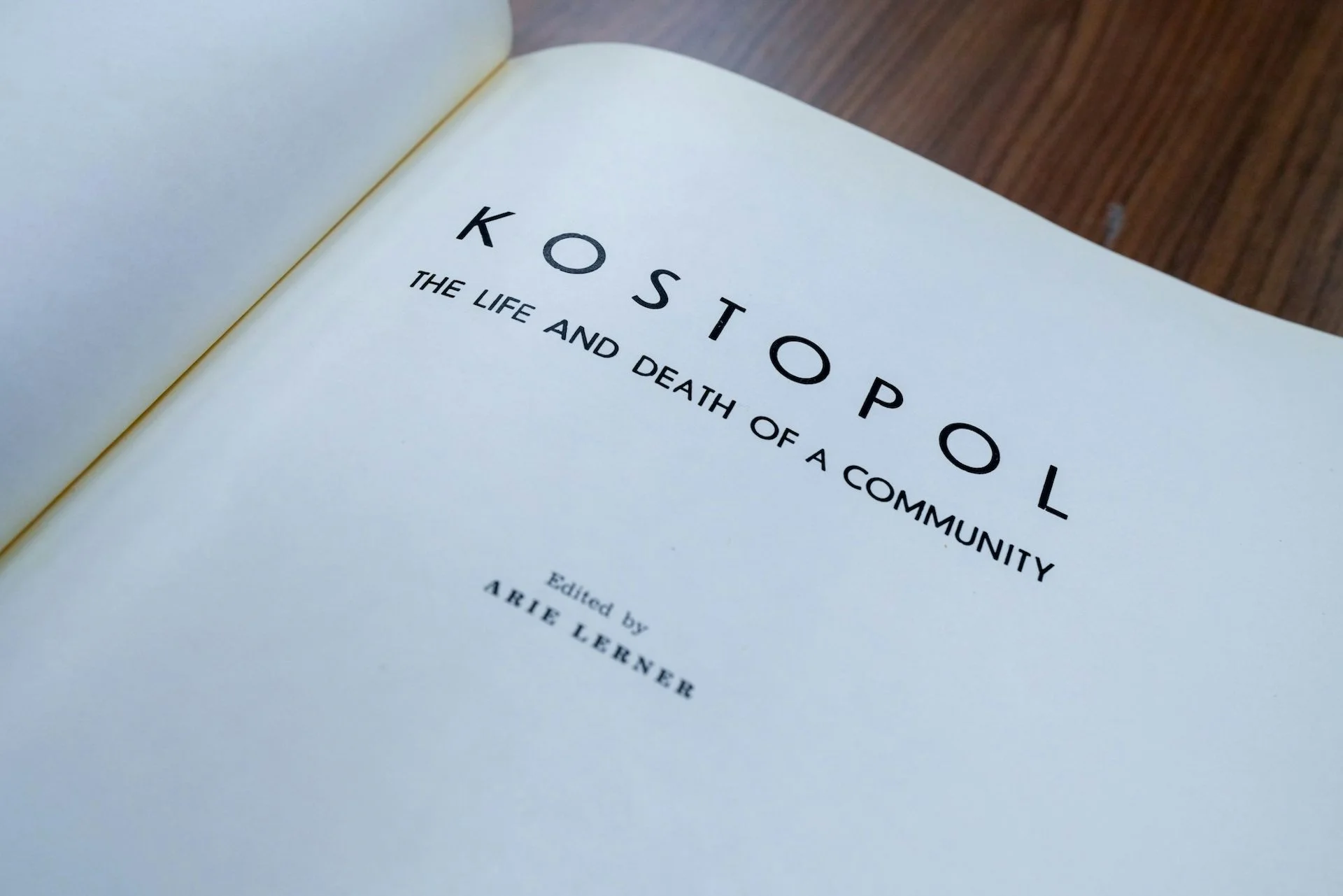
For Jennifer Rich, a scholar of Holocaust memory, the books became personal when she searched for traces of her grandmother, a survivor from Kostopol, Ukraine. Rich knew little about her grandmother’s life before the war. In her account of the discovery, she describes finding “Sefer Kostopol,” or “Book of Kostopol,” and locating her grandmother’s name among lists of survivors. The same volume named her grandmother’s murdered mother and sister.
The book did not resemble a conventional history. It read more like a community-made collection: essays from residents, photographs, survivor lists and the names of those who had been killed. Rich’s search led her to a much larger body of work: over 1,000 memorial books, known in Yiddish as yizker bikher.
These volumes were assembled after the Holocaust by people determined to remember both the dead and the places they had called home. In many, roughly two-thirds of the material describes life before the war. The rest records the Nazi occupation, personal accounts of persecution and murder, and lists of those who did not survive.

The choice to devote so much space to ordinary life gives the books their distinctive force. School groups, sports teams, market squares and busy streets appear alongside stories of occupation. Contributors write about neighbors, work, celebrations and disagreements. Their accounts insist that these towns were lived-in places, shaped by relationships and routines, before they became sites of mass violence.
The images and documents deepen that sense of place. Some books include maps drawn from memory, with rivers, forests, streets and local nicknames supplied by former residents. Others reproduce sketches, photographs, posters, budgets, song lyrics, book covers, event flyers and school report cards. The material may be informal, but its specificity helps reconstruct a world that survivors feared would disappear from memory.

Amateur artists contributed some of the illustrations, while other books featured work by established figures, including Polish-Jewish illustrator and political cartoonist Arthur Szyk. Taken together, these materials give the books the texture of community archives assembled by people with different memories, skills and priorities.
A familiar form rebuilt by survivors
The earliest volume Rich studied came from Volkovisk, Belarus, and was published in 1946, one year after the liberation of Auschwitz. The speed with which survivors began gathering accounts and organizing publications is striking. They turned to a form that had long served Jewish towns: the “pinkes,” or community register.
As described in scholarship on the pinkes, these registers recorded a community’s public life, from meeting minutes and school budgets to political candidates. Yizker bikher drew on that tradition, while adapting it to the task of remembering communities shattered by the Holocaust. Their organization can be loose and uneven, reflecting the many contributors who helped create them.

The connection between the old registers and the new memorial books was sometimes explicit. Some titles included the word “pinkes,” and editors described their work as part of a continuing record of Jewish communal life. Eliezer Yerushalmi, who compiled the memorial book for Navaredok, Belarus, framed the volume as a link between generations.
“Each pinkes is a link in a timeless chain recording the history of Jewish communities,” he wrote. The Navaredok volume, he explained, would tell “the orphaned generation and the generations to come” what the community had experienced over centuries, “to its terrible destruction.” That intention gives the books a double purpose: they memorialize people and preserve a history that began long before the war.

Survivor groups in the United States, Canada, Israel and Argentina also shared methods and resources. Committees sometimes worked with the same editors and borrowed approaches from earlier books, a pattern that Rich discusses in her work on the memorial book tradition. Planning could take years. A prospectus for the Wielun Memorial Book was circulated in 1961; the volume appeared in 1971.
The Wielun memorial book must be a reflection of a former home, which was so brutally destroyed and erased. In the book of remembrance, all moments, events, adventures, and experiences need to be expressed. Different facts, good deeds, memories, figures, and types. Let nothing be forgotten: days of sadness, days of joy, and hope for a better tomorrow.
“Let nothing be forgotten” captures the breadth of the project. The books were meant to hold grief and joy together, and to give future readers a record of lives that could not be recovered through lists of victims alone.
Why these books matter now
For years, yizker bikher received limited attention from scholars. Their mix of memoir, documentation, religious reference, secular detail and visual material resists neat labels. They can feel nostalgic, but they also preserve evidence. They include photographs without being photo albums, and historical records without following the structure of a conventional history.

Interest has grown in recent years, with researchers examining the books and the archives behind them. Recent work has used them to study prewar Jewish life, the intimate effects of Nazi violence and the ways survivors commemorated loved ones. Popular writing and academic research have also brought more attention to the collections.
The books offer a vital complement to the history of the Holocaust. They document the murder of six million Jews, but they also help readers see the communities and individuals who existed before that crime. In preserving local memories, survivors shaped how their towns would be remembered: not only through their destruction, but through the everyday lives, attachments and traditions that made them homes.

Jennifer Rich does not work for, consult, own shares in or receive funding from any company or organization that would benefit from this article, and has disclosed no relevant affiliations beyond their academic appointment.

