Young Americans’ political information doesn’t stop at news feeds. Influencers, podcasts, comedy and video games bring political ideas to audiences whose entertainment tastes cross party lines. A survey of 741 Americans ages 18 to 49 finds that the same creators and titles often appeal to Democrats, Republicans and independents. The overlap matters: popular culture can shape the political atmosphere people absorb, even when they don’t seek out political news.
Research on political polarization often tracks partisan news preferences and social media habits. Studies describe how people’s preferred news outlets and social media use can create information environments dominated by familiar views. Popular entertainment gets less attention, despite the political ideas carried by popular culture—from comedy and television to films, podcasts and online personalities.
The connection is visible in public life. The president is a former reality television star who won reelection in 2024 with support from, among others, comedy podcasters such as Joe Rogan. A film like “The Odyssey” can ignite controversy and become a political flashpoint. Late-night hosts, meanwhile, have had to navigate regulatory pressure while making political comedy.
We know more about Republicans’ and Democrats’ news habits than about the entertainment they consume alongside that news. The gap is notable for younger audiences, who are increasingly exposed to political content from influencers and popular culture.
Political consultant Sarah Longwell of The Bulwark described the shift in a conversation with The New York Times’ Ezra Klein. Her focus groups, she said, include people who get political information from an “algorithm-driven information environment” featuring influencers, comedians and sports personalities. The “overlap between politics and culture,” in her words, helps create a “vibe” that informs political decisions.
As co-founders and research affiliates of Colorado State University’s Center for Democracy, Art, and Popular Culture, we surveyed Americans ages 18 to 49 about their entertainment preferences. We wanted to see whether the partisan sorting found in news use also showed up in entertainment. The survey points to a different pattern: many favorites are shared across political affiliations.
Shared names across influencers and podcasts
We asked 741 respondents to name their favorite influencers, podcasts, comedians, musicians, video games, films and television series. They first identified the kinds of pop culture they engage with, then listed favorites in each category. Responses varied widely, but the most frequently named creators reveal common ground across party lines.
Both Democrats and Republicans have sought to reach younger voters through influencers, many of whom don’t follow traditional political news. The survey’s top influencer results help explain why these creators can matter beyond a single party’s audience.
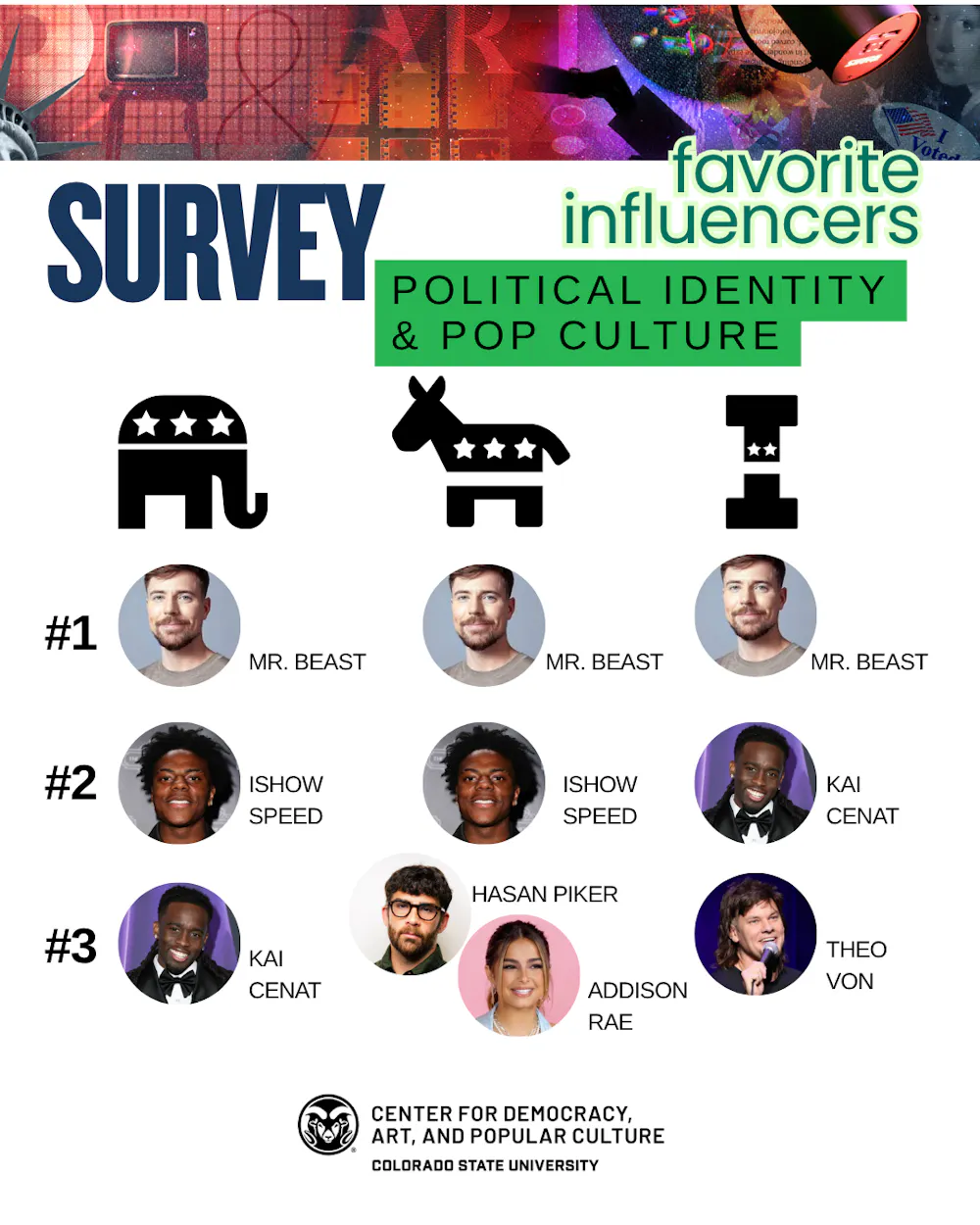
MrBeast topped the favorite-influencer lists for Democrats, Republicans and independents. Republicans and independents also placed Kai Cenat among their top three, while IShowSpeed ranked second for Democrats and Republicans. These creators built large audiences through viral stunts, celebrity interviews and gaming content on platforms including YouTube and Twitch. MrBeast was the shared top pick.
Podcast favorites show a similar mix. “The Joe Rogan Experience” and “Call Her Daddy” appeared in the top three for every political group. Republicans and independents also included the “Tucker Carlson Show” and “This Past Weekend with Theo Von.” Rogan and Von moved from comedy into podcasting; Carlson became known as a right-wing commentator. “Call Her Daddy,” hosted by Alex Cooper, stands apart among these leading shows as a woman-hosted podcast known for frank conversations about sex and relationships.

Podcast audiences can have political consequences. Campaigns & Elections reported that, among registered voters surveyed who listened to at least one podcast each month, half said podcasts had some influence on their vote in 2024. The report also found that podcast listeners favored conservative candidates in that presidential election. The shared popularity of Rogan offers one possible context: he has expressed libertarian views and hosted right-wing politicians, while Von occupies a similar cultural space. Carlson is a conservative voice, yet both men appear among the favorites of independents as well as Republicans.
Comedy and games create more points of contact
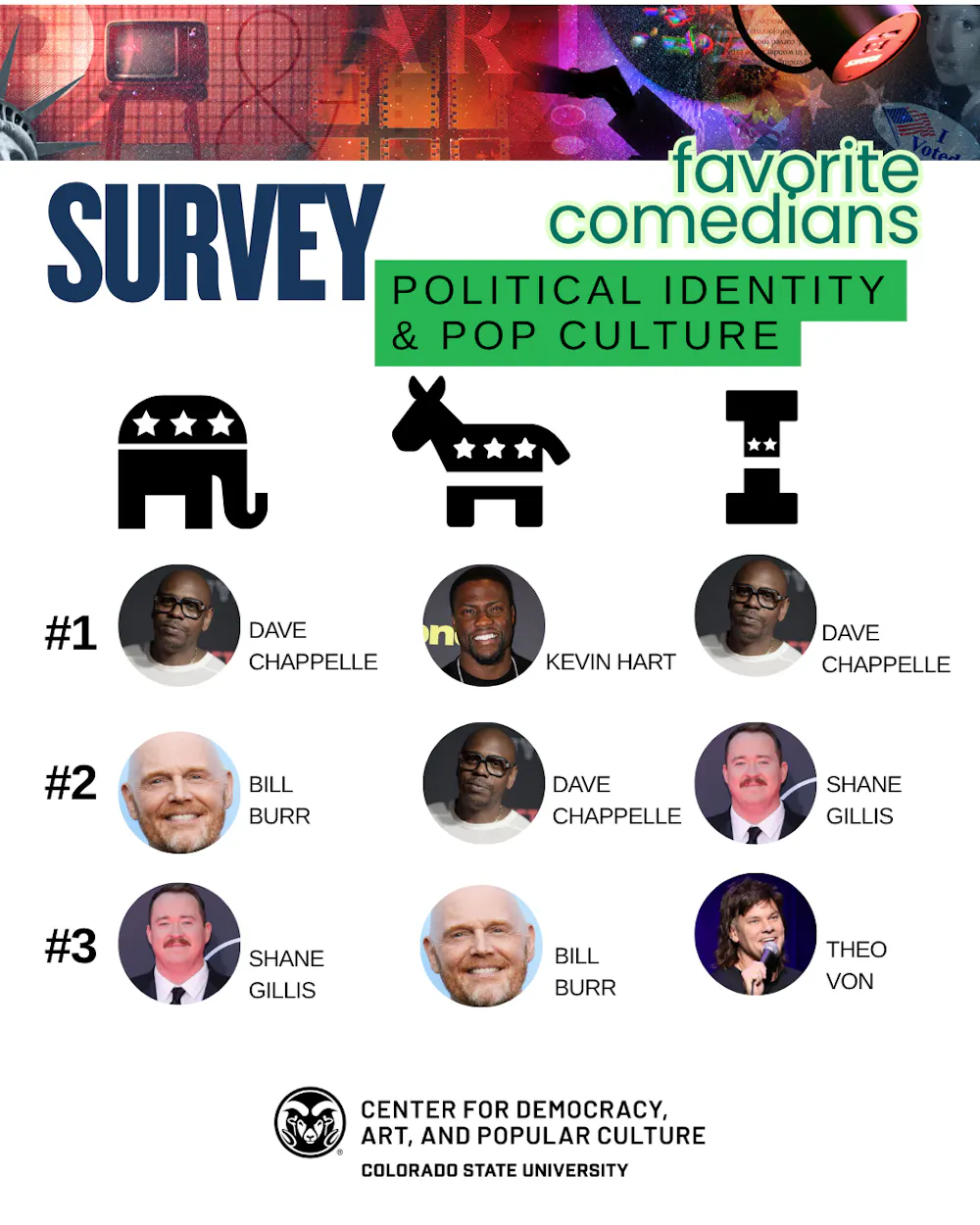
Comedy can shape political attitudes, as political scientists and media scholars have shown. Our results suggest that comedy preferences also cross partisan boundaries. Dave Chappelle, creator of “Chappelle’s Show,” was the top comedian for Democrats and Republicans and ranked second among independents. Bill Burr made the top three for Democrats and Republicans. His comedy has been described as cocky and aggrieved. Shane Gillis, whose work the New York Times said “fits into the evolving meaning of conservatism,” ranked second for independents and third for Republicans.
Video games offer another shared venue. Players encounter one another through multiplayer sessions, Twitch streams and comment sections, sometimes discussing politics while taking part in activities that aren’t political by design. Research finds that young people can meet a range of political views through online activities that have no overt political purpose. One study traced how a Fortnite trend involving building “Trump’s wall” led to political exchanges inside the game and across gameplay videos and social media.
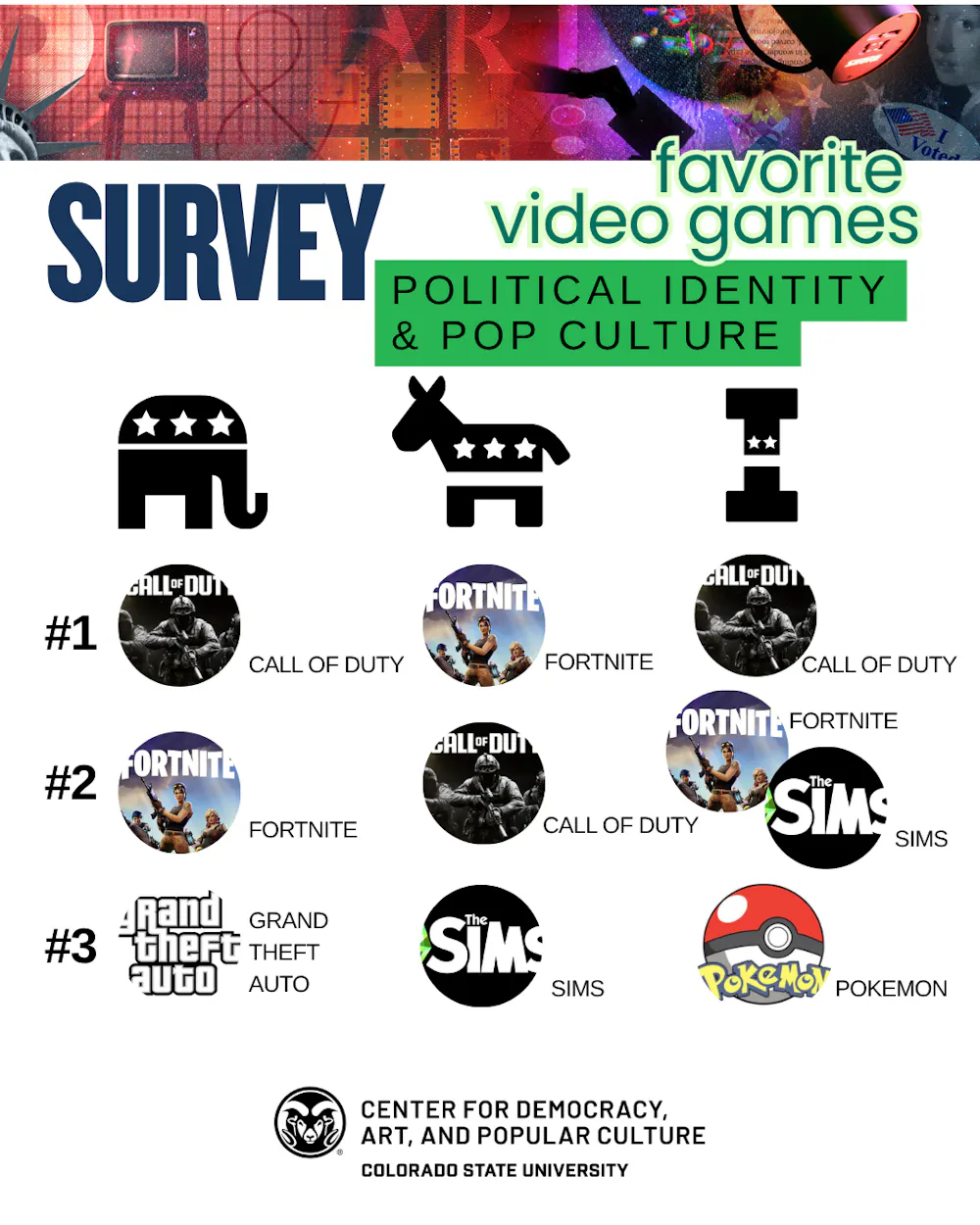
The medium can also host deliberate political outreach. In 2020, U.S. Rep. Alexandria Ocasio-Cortez livestreamed a game of Among Us with U.S. Rep. Ilhan Omar and prominent gamers. The online deduction game resembles party games such as Mafia and Werewolf. The stream was framed as a get-out-the-vote effort and drew 4.5 million views. In our survey, Call of Duty, Fortnite and The Sims appeared among the favorite games of all three political groups.
Shared audiences, uneven representation
Cross-party popularity doesn’t make entertainment politically neutral. Several prominent male creators in the survey—including Rogan, Von, Carlson and Gillis—appeal to or have helped shape what’s called the manosphere: a loose set of online communities centered on masculinity, where misogynistic attitudes often appear.
The pattern isn’t limited to creators identified with conservative politics. Burr’s comedy isn’t politically conservative, though the New York Times described it as giving voice to “the aggrieved confusion of the white heterosexual guy adrift.” Chappelle has built a reputation for satire about racism, while his recent Netflix specials drew criticism for anti-trans remarks. Mother Jones characterized those comments as anti-trans sentiments that it said were “indistinguishable from, and grist for, the material of conservative streamers and right-wing edgelords.”
The survey didn’t ask people why they chose particular entertainers or games. Audiences also don’t simply absorb every message a creator sends; research has shown that viewers interpret and respond to pop culture in varied ways. Still, the lists show how male creators dominate several high-profile categories, while misogyny and transphobia remain part of some popular commentary and comedy.
That combination deserves attention. The audiences around entertainment aren’t sorted as neatly by party as audiences around news outlets, so the cultural cues attached to popular creators can travel across political groups. The shared favorites in this survey point to a broad arena where political identity is shaped through entertainment—and where the voices setting its tone are disproportionately men.

The authors do not work for, consult, own shares in or receive funding from any company or organization that would benefit from this article, and have disclosed no relevant affiliations beyond their academic appointment.

