Radio flares may offer astronomers a way to track some high-energy neutrinos back to their cosmic sources. A study published in October 2026 found that IceCube detections appear in the same parts of the sky as brightening radio sources more often than chance alone would suggest. The result is intriguing, but it remains an early lead: the apparent association covers only about 13% of the astrophysical neutrinos in the analysis, and the odds of a chance pattern are still roughly one in 30.
That uncertainty matters because neutrinos are unusually direct messengers of energetic events, yet exceptionally difficult to catch. They can cross vast distances and pass through planets without interacting. IceCube, a detector embedded in Antarctic ice, has opened a new window on high-energy neutrinos from space. Pinpointing where those particles come from could help researchers understand the powerful processes taking place inside objects such as quasars.
Why neutrinos are hard to trace
Most familiar particles interact with matter through electromagnetism, the force behind light and chemistry. Neutrinos interact instead through the weak interaction, which operates over distances smaller than an atomic nucleus. Unless a neutrino passes very close to an atom’s center, it will keep going without leaving a detectable trace. A detector therefore needs to watch a large volume of material for a long time to catch even a small number of interactions.
Scientists have detected neutrinos from space since the 1960s, including particles from the Sun and, in one landmark case, a supernova. IceCube extends that work by using the South Pole’s dense ice as a detector. When a neutrino does interact with a water molecule in the ice, the resulting radiation can be recorded by sensors and used to estimate the particle’s direction and energy.
That method has allowed IceCube to detect astrophysical neutrinos with energies hundreds of thousands of times greater than those observed previously. These particles can reveal high-energy activity in regions that light may not escape. The difficulty is connecting a detection to a particular object in the sky. A neutrino’s ability to pass through matter makes it a valuable messenger, but also leaves researchers with few interactions to use as signposts.
Quasars are candidates, but gamma rays leave gaps
Quasars are among the suspected sources. In these objects, matter near a black hole millions of times more massive than the Sun can produce intense emissions. IceCube detected a neutrino in 2017 that appeared to come from the direction of the quasar TXS 0506+056. A telescope also observed a gamma-ray outburst from the same object around that time, offering a notable case in which neutrino and electromagnetic observations lined up.

Neutrino-producing processes are expected to generate high-energy electromagnetic radiation as well, including gamma rays. Yet one matching quasar does not establish that quasars account for most neutrinos, and observations so far have not shown a broad, consistent link between gamma-ray outbursts and neutrino detections.
There’s a practical reason gamma-ray observations may miss some sources: gas and dust around a supermassive black hole can absorb or block gamma rays before they reach Earth. Radio waves travel through such material more readily. That makes radio astronomy a possible way to spot activity that gamma-ray telescopes cannot see, even when the radio data cannot detect the neutrino itself.
A possible connection in radio survey data
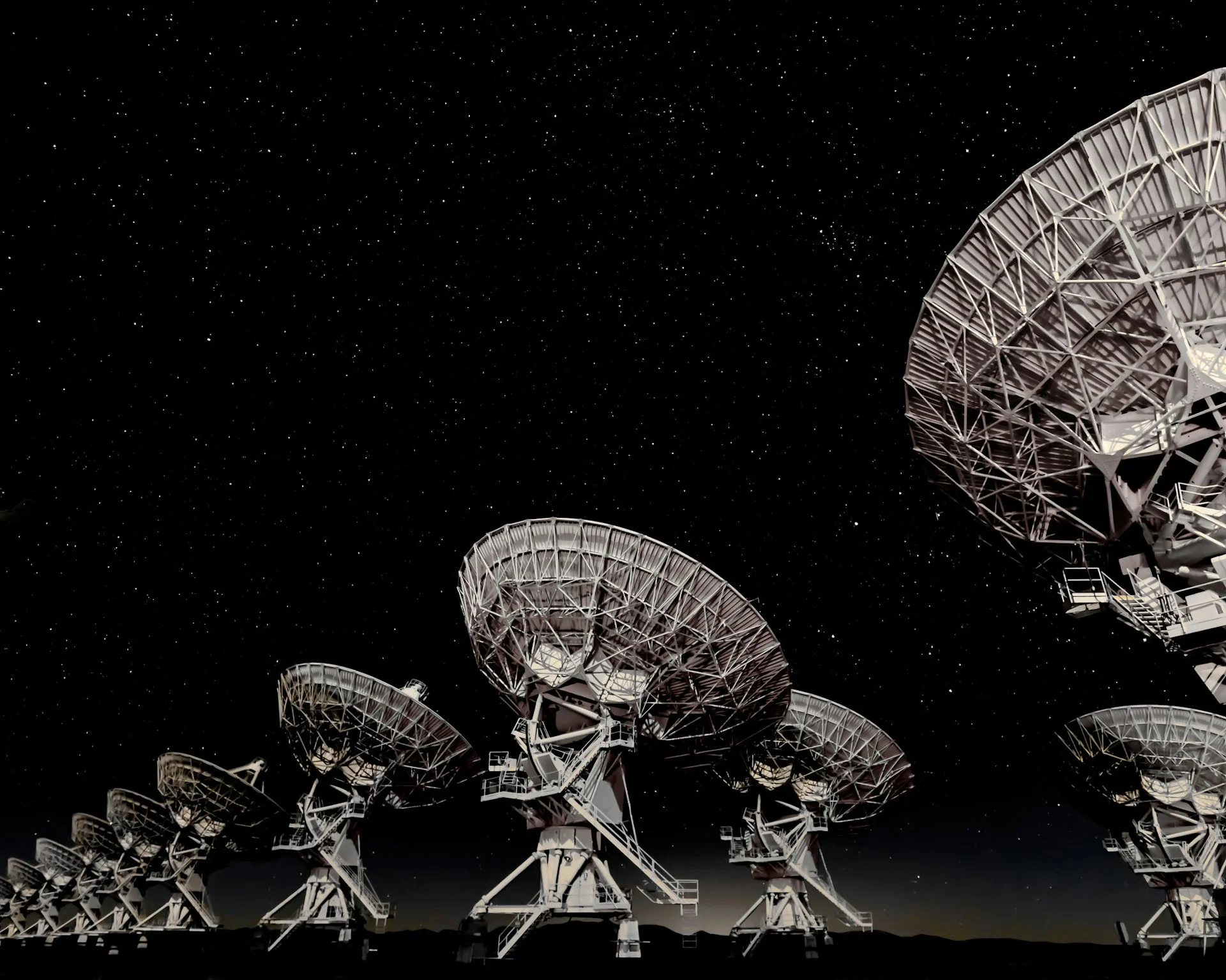
The study draws on the Very Large Array Sky Survey, or VLASS, which began tracking changes in radio brightness across the sky in 2017. The Very Large Array, in New Mexico, gathers radio observations that can be combined to map astronomical sources. In earlier work, the researchers found that most VLASS objects with changing radio emissions are quasars, the same broad class of object implicated by IceCube’s 2017 detection.
The team then compared the timing and sky positions of IceCube neutrinos with radio flares in the VLASS data. They found that a radio source was brightening in the relevant part of the sky more often than expected if the two sets of events were unrelated. The pattern suggests that some neutrino sources may be associated with radio-bright quasars or similar objects.
The limits are as important as the signal. The possible radio association applies to about 13% of the astrophysical neutrinos IceCube detected in the analysis, leaving most without an identified counterpart. And more than 90% of the radio outbursts that might be associated with neutrinos were not detected by gamma-ray telescopes. That supports the case for looking at radio emissions, while leaving the actual origins of most neutrinos unresolved.
More observations will decide the case
The researchers estimate that there is about a one-in-30 chance of seeing a pattern like this even if radio flares and neutrinos have no real connection. That is suggestive, but it falls well short of the level of confidence scientists typically seek for a strong result. More data are needed to determine whether the apparent alignment reflects a physical relationship or a statistical coincidence.
The team expects additional observations over the next few years. Those measurements could strengthen the association, weaken it, or help identify which kinds of radio sources matter. For now, the finding gives neutrino astronomers a promising line of inquiry: compare IceCube’s sparse detections with radio surveys that can reveal activity hidden from gamma-ray instruments. If the pattern holds, radio telescopes could help fill in the map of where high-energy neutrinos begin.

Yjan Gordon does not work for, consult, own shares in or receive funding from any company or organization that would benefit from this article, and has disclosed no relevant affiliations beyond their academic appointment.

