Two surveys, neither supports Badenoch’s full claim
The key problem with Kemi Badenoch’s claim is that the survey closest to her “seven quarters” figure contradicts her account of the record. The figures support a sustained period of weak business confidence, but they don’t support her claim that this has never happened before or that confidence was last positive under a Conservative government.
That distinction matters. A run of negative readings can describe a real stretch of business pessimism, while the historical comparison attached to it can still be wrong. The length of the run, its starting point and what counts as a positive reading all depend on the survey being used.
Responding to the Budget on Wednesday, Conservative Party leader Kemi Badenoch said: “Business confidence is negative, not just this quarter, and not just the last quarter, but for seven quarters in a row. That has never happened before.
“In case Labour MPs do not understand what that means, the last time business confidence was positive was when we were in charge.”
The Press Association could not find a measure matching all of those claims, despite searching traditional search engines and AI tools. The difficulty isn’t that the surveys show no weakness; they do. It’s that the statement combines a particular duration with a claim about the entire historical record and a claim about which party was in office when confidence last turned positive.
The IoD figures don’t fit
Asked what data Badenoch had cited, the Conservatives pointed to the Institute of Directors’ survey. Its Directors’ Economic Confidence Index tracks business leaders’ optimism about the UK economy. Its readings have been negative for an extended period, according to the published chart, but the details clash with Badenoch’s account.
Her statement describes consecutive quarters; the IoD index is monthly and appears to omit some months. It has been negative since August 2024—just under nine quarters, rather than seven. That makes it a poor fit for the count as stated, even though it does show a long period in which surveyed business leaders were pessimistic about the UK economy.
And the negative run is not unprecedented: it began in September 2021 and ended in July 2024. The earlier stretch is a direct problem for the claim that this has “never happened before”. A monthly index also shouldn’t be treated as interchangeable with a quarterly one: each measures confidence on its own schedule, and a change in frequency can change how a run is described.
That July 2024 positive reading came from research conducted between July 19 and July 30, after Labour took office. Before then, the index had last been positive in July 2021. The Conservatives have not responded to questions about these discrepancies.
ICAEW matches the seven-quarter count, but not the history
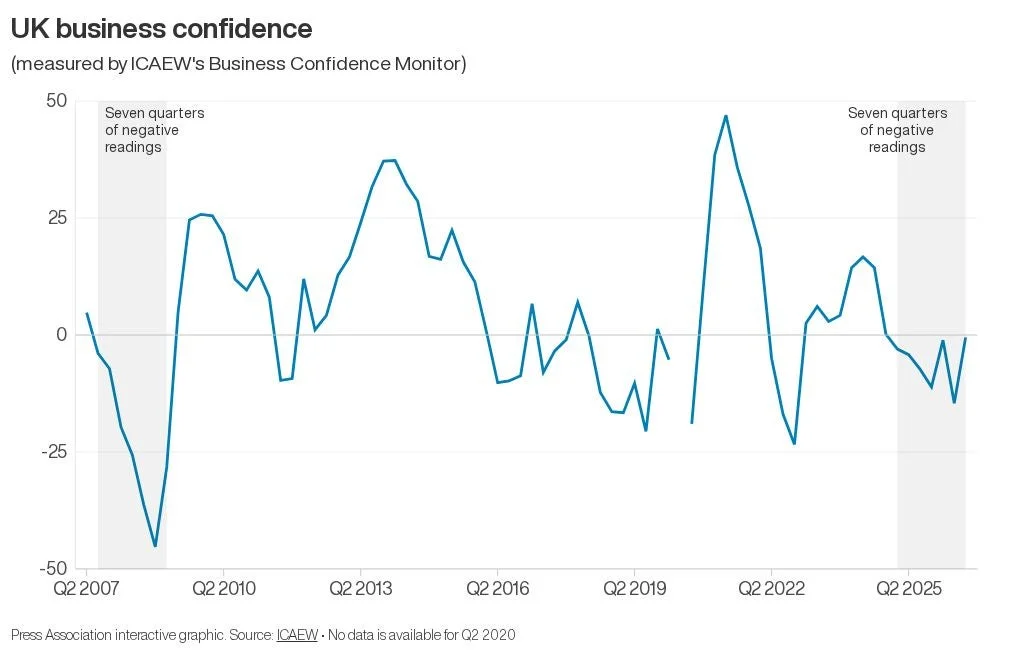
A more plausible source is the Institute of Chartered Accountants in England and Wales’ Business Confidence Monitor. It reports quarterly results and shows seven consecutive negative quarters, aligning with one part of Badenoch’s statement. Here's the thing: matching the count doesn’t validate the rest of the claim.
But the historical record undercuts the rest. The ICAEW says the current run matches an earlier seven-quarter stretch during the financial crisis. Its figures also show that confidence was positive in the fourth quarter of 2024, after Labour had been in power for several months. The previous quarter—the first based on research conducted under Labour, from July 15 to September 20, 2024—was positive too.
The timing of the research matters because a quarterly result reflects responses gathered over a period, rather than a single day. That makes party attribution less tidy than a speech can imply: the survey’s label may cover weeks that cross a change of government, while the resulting score captures respondents’ views across that period.
The distinction matters if you’re using confidence surveys to judge a government’s economic record: the result depends on which index you choose, and neither survey supports Badenoch’s full version of events. This is more significant than it looks. “Business confidence” sounds like one settled measure, but these two surveys differ in frequency and in the historical comparisons they allow.
What the figures can—and can’t—show
Both surveys point to a genuine period of subdued confidence, and that is a relevant signal about how business leaders view economic conditions. It doesn’t, by itself, establish why confidence is weak or assign responsibility for it. A survey records responses within its own method and timeframe; political claims need to preserve those limits.
If you're working in this space, the useful questions are basic: which survey is being cited, what period does it cover, and does its record support the historical comparison attached to it? Here, the quarterly ICAEW measure fits the seven-quarter count but records an earlier run of the same length. The monthly IoD measure shows a different duration and a prior negative period.
That said, the mismatch doesn’t erase the underlying signal. Business confidence has been weak for a sustained period in the figures cited. The narrower, defensible point is that the surveys support prolonged pessimism, while the claim about an unprecedented run and the last positive reading does not hold up across them.
One complication remains. (And this is the part most people overlook.) A positive result in a survey doesn’t mean every business is confident; it means the index crossed its stated threshold. The boundary between positive and negative is useful for tracking direction, but it can make a complex spread of opinion sound like a simple verdict.
So the headline number needs its source attached. Seven quarters is supported by one survey, but the same survey says the run has happened before; the other survey doesn’t match the seven-quarter framing and also records an earlier period of negative confidence. The political argument is sharper than the evidence.

Sources
Hansard – Wednesday 28 October 2026
IoD Directors’ Economic Confidence Index – 1 October 2026 (archived)
IoD Directors’ Economic Confidence Index – chart from October 2026 (archived)
IoD Directors’ Economic Confidence Index – chart from July 2024 (archived)
IoD Directors’ Economic Confidence Index – 1 September 2024 (archived)
IoD Directors’ Economic Confidence Index – 30 September 2021 (archived)
IoD Directors’ Economic Confidence Index – 1 August 2024 (archived)
ICAEW – UK Business Confidence Monitor: National – Q3 2026 (archived)
ICAEW – UK Business Confidence Monitor: National – Q4 2024 (archived)
ICAEW – UK Business Confidence Monitor: National – Q3 2024 (archived)

