The Philippines’ electronic invoicing requirement is a systems and process deadline as much as a tax task. Covered businesses must issue compliant electronic invoices on or before December 31, 2026, under Revenue Memorandum Circular No. 98-2026. That means finance, tax, and IT teams need to establish both whether their company is covered and whether its invoicing setup can meet the required format, permits, and controls.
The circular distinguishes issuing electronic invoices from transmitting sales data to the Bureau of Internal Revenue (BIR). Companies should prepare systems that can support electronic reporting, but the reporting obligation depends on the BIR issuing implementing policies and procedures. A Permit to Transmit is required when the Commissioner notifies or directs the taxpayer to obtain one.
Here’s the thing: a billing platform that produces a PDF may still fall short. The relevant question is whether the system generates structured invoice data, delivers invoices through electronic channels, and can support the required BIR data processing.
Start with the coverage assessment
RMC No. 98-2026 covers several taxpayer groups, subject to an exemption for micro taxpayers. These include small, medium, and large taxpayers engaged in e-commerce or internet transactions; taxpayers under the Large Taxpayers Service (LTS); and taxpayers classified as large under the Ease of Paying Taxes Act and Revenue Regulation No. 8-2024.
The coverage list also includes taxpayers using a Computerized Accounting System (CAS), computerized books of accounts with accounting records and electronic invoicing, or other invoicing software. The Commissioner of Internal Revenue may require other taxpayers to comply as well.
Companies should check each category against their own activities and systems. A business’s absence from the LTS, by itself, doesn’t establish that it is exempt. Nor is e-commerce limited to online retail: the circular includes commercial transactions involving physical or digital goods and services conducted through electronic networks.
Foreign ownership doesn’t settle the question
For a multinational group, the assessment should follow the Philippine entity and the transaction. Which entity makes the sale? Which one issues the invoice? What taxpayer classification and invoicing system apply to that entity? A Philippine subsidiary or registered branch should assess its own position; a regional billing center or foreign parent system doesn’t answer those questions on its own.
Nonresident digital service providers have separate rules to consider. Revenue Regulation No. 3-2025 allows nonresident VAT-registered providers to issue electronic sales or commercial invoices without registering those invoices with the BIR, provided the invoices meet prescribed information and language requirements. Companies should assess those rules separately instead of assuming that the domestic Permit to Issue process applies to every overseas platform selling to Philippine customers. (READ: [Ask the Tax Whiz] Guidelines on VAT for Nonresident Digital Service Providers)
PDF delivery is only one part of compliance
Under the circular, a compliant electronic invoice must be generated using duly registered, approved, or accredited accounting or invoicing software and use a structured electronic format. It must be generated electronically and delivered through recognized channels, which may include email, online viewing, QR codes, applications, or web platforms. Its data must also be capable of electronic extraction, processing, and transmission to the BIR for sales reporting.
A PDF may be the version a customer sees, but the underlying system and data still need to meet those requirements. An invoice manually created in Word, Excel, Google Docs, Google Sheets, or similar productivity software doesn’t qualify. Printed copies are permitted and must be provided when a buyer requests one, but printing doesn’t make a noncompliant system compliant.
Companies also need to account for the permit and certification steps. A taxpayer must obtain a Permit to Issue (PTI) Electronic Invoice before generating or issuing electronic invoices. The application goes to the Revenue District Office or Large Taxpayer Office where the taxpayer is registered, with the prescribed supporting documents. The circular provides for evaluation within 20 working days after the office receives a complete application.
An existing CAS Permit to Use or Acknowledgement Certificate doesn’t, on its own, authorize electronic invoice issuance. After receiving a PTI, the taxpayer must obtain Electronic Invoicing and Sales Reporting (EIS) Certification within six months. Failure to secure certification can lead to PTI revocation. The certification checks whether the system can extract, process, and transmit sales data according to BIR standards. Technical guides are available through the EIS Certification Portal. That six-month window is a certification period after PTI issuance, not an extension of the December 31, 2026 invoicing deadline.
Map platforms, branches, and data before applying
The circular allows businesses to use an in-house system, commercially acquired software, or services from an Electronic Invoicing Service Provider (ESP). Companies may keep other structured formats for internal work if they can convert the necessary sales data into the BIR-prescribed format. The existing EIS uses JavaScript Object Notation (JSON) for sales data transmission.
For global ERP platforms, the practical issue is whether the current setup can support Philippine requirements through configuration or integration. Finance and IT teams should walk through customer and taxpayer identifiers, branch details, VAT treatment, discounts, withholding tax information, invoice references, and reconciliation against accounting records. The circular says ESP policies and guidelines will come in a separate issuance, so companies should verify any provider’s claimed authorization and keep track of their own PTI and certification obligations.
Coverage extends to the head office and every registered branch, even when only one branch carries out the covered activity. PTIs for a head office and its branches use the same PTI number while identifying the relevant branch. Each distinct invoicing system requires a separate PTI that identifies the offices or locations authorized to use it. A migration, replacement, or other change to the approved platform or core system details requires a new or amended PTI, as applicable.
For a company running several billing platforms, that makes a branch-to-system map an essential early task. It gives the implementation team a clearer view of which applications need changes, which locations use each platform, and where separate permits may be required.
Build in recovery and correction controls
The invoice obligation continues during an outage. If an interruption prevents electronic issuance, the taxpayer must use a BIR-authorized manual invoice. After the system returns, the business must replace those manual invoices with corresponding electronic invoices that carry the manual documents’ reference numbers.
That process calls for clear staff responsibilities, access to authorized manual invoices, and a reconciliation step after recovery. The aim is to account for every sale without recording it twice or leaving a transaction out.
Issued electronic invoices cannot be deleted, edited, or modified. Corrections must be made through another document that refers to the original: a duly authorized credit note or credit memo for a decrease, or a new electronic invoice for an increase. For example, if an invoice records ₱50,000 instead of ₱5,000, a ₱45,000 credit note or memo corrects the overstatement while preserving the original invoice record.
Billing software should therefore prevent users from overwriting issued invoices and provide a traceable adjustment process. That control matters in high-volume billing, as well as when handling refunds or subscription changes.
Classification changes need follow-up
A taxpayer that moves to a lower classification doesn’t automatically stop being covered. It must continue complying unless the BIR says otherwise in a separate issuance. If a taxpayer moves to a higher classification, the circular refers to a compliance period set by the BIR that must be at least six months from the reclassification date. That wording doesn’t establish a universal six-month deadline.
Turn the deadline into a readiness plan
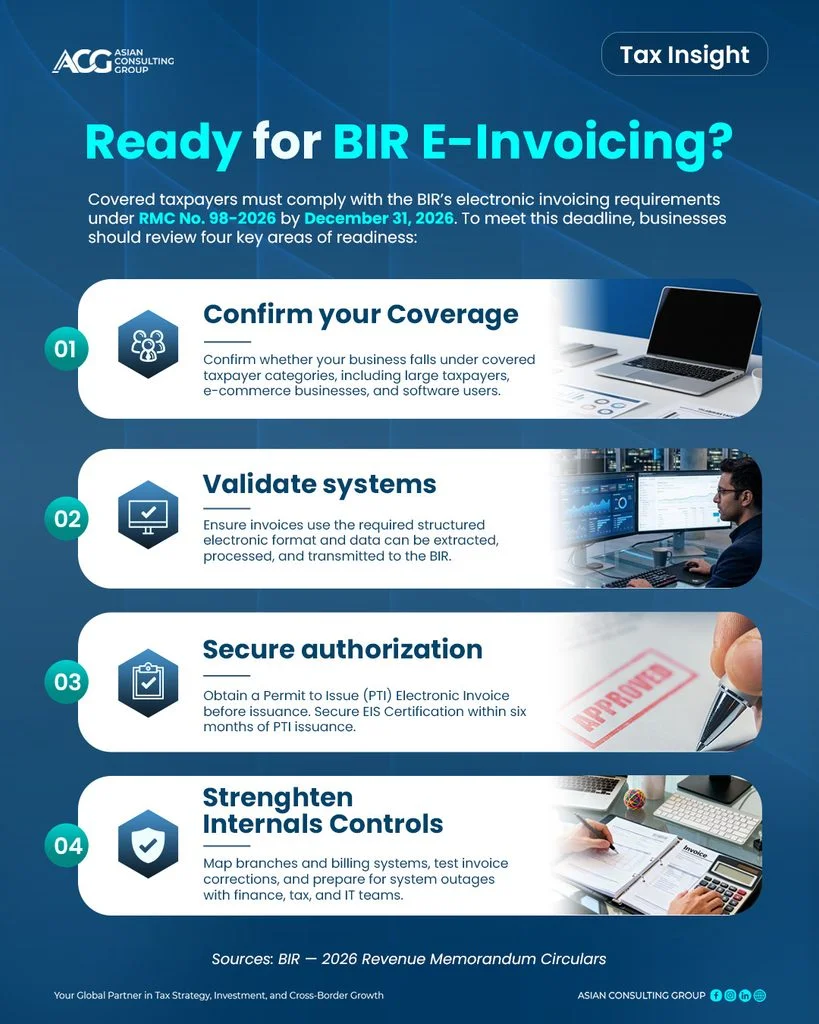
Corporate leaders should bring finance, tax, and IT together to confirm coverage, inventory invoicing systems and branches, identify system changes, prepare PTI applications, and schedule certification work. Testing should cover corrections and outage recovery as well as ordinary invoice generation. It should also check how invoice data connects to accounting records and whether each branch uses the system it is authorized to use.
The distinction between invoice issuance and sales reporting should guide planning: the December 31, 2026 deadline applies to electronic invoicing, while sales reporting procedures depend on further BIR direction. Companies that settle their coverage, system map, permit path, and failure procedures early will have a clearer route to implementation as the deadline approaches.
– Rappler.com
For more tax information and inquiries, visit www.acg.ph.
Mon Abrea, CPA, MBA, MPA (Harvard), is a global tax policy expert and Chief Tax Advisor of Asian Consulting Group (ACGlobal). He advises governments, multinational enterprises, and international organizations on tax policy, investment competitiveness, and fiscal reform. He is the author of Reimagining the World Without Corruption and Why Invest in the Philippines? CREATE MORE Edition, and has represented the Philippines in policy dialogues at the OECD, World Bank, and other international forums.